What Is VO2 Max and Why Does It Matter?
The fitness number most strongly linked to living longer, and how to improve it
If you wear a smartwatch, you've probably noticed a number called VO2 max sitting somewhere in the app. Most people ignore it. As a personal trainer in Redcliffe, I think it's one of the most useful numbers you can track, because the research links it to how long and how well you live. Here's what VO2 max is, what the evidence says, and how to improve yours, whatever your starting point.
What is VO2 max?
VO2 max is the maximum amount of oxygen your body can take in and use during hard exercise. It's the gold-standard measure of cardiorespiratory fitness: how well your heart, lungs, blood vessels and muscles work together. It's often expressed in METs (one MET is your resting energy use). In practical terms, one extra MET of fitness is roughly the same as being able to run or jog 1 km/h faster (Kodama et al., 2009).
Your smartwatch estimates it from your heart rate and pace. It's not as accurate as a lab test, but it's useful for tracking whether you're trending up or down.
Is VO2 max linked to living longer?
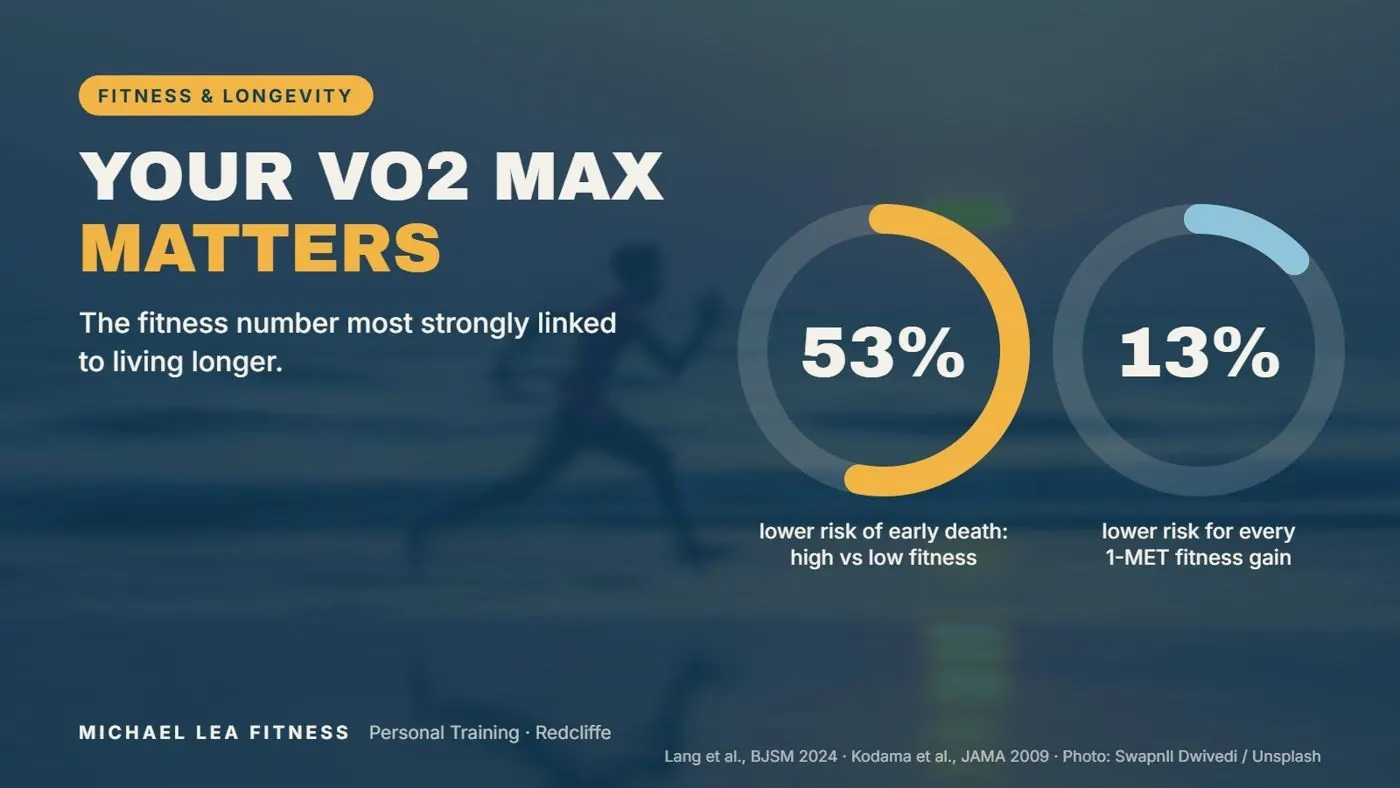
Yes, strongly. A meta-analysis of 33 studies and more than 100,000 people found that every 1-MET increase in fitness was linked with a 13% lower risk of death from any cause, and a 15% lower risk of heart disease and cardiovascular events (Kodama et al., 2009).
A much bigger 2024 overview pulled together meta-analyses covering 199 cohort studies and more than 20.9 million observations. People with high cardiorespiratory fitness had a 53% lower risk of early death than people with low fitness, and each 1-MET increase was linked with an 11% to 17% lower risk (Lang et al., 2024).
One honest caveat: these are observational studies, so they show a strong link rather than proof that fitness alone causes the difference. But the pattern has been consistent for decades.
Does fitness matter more than your weight?
This is one of the most encouraging findings in the research. A 2025 meta-analysis of nearly 400,000 observations compared people by both fitness and body mass index (BMI). People who were overweight or obese but fit did not have a statistically different risk of dying than fit people in the healthy weight range. People who were unfit had two to three times the risk, whatever their weight (Weeldreyer et al., 2025).
That doesn't mean weight doesn't matter for your health. It does mean the scales shouldn't be the only number you care about. Getting fitter is worth it even before the weight comes off.
What's the best way to improve VO2 max?
Almost any regular cardio will improve it if you're starting from a low base. A 2026 Cochrane review of 58 randomised trials in healthy but inactive adults found that high-intensity interval training (HIIT) likely improved VO2 max compared with doing no exercise, and may have improved it slightly more than steady moderate-intensity cardio (Strauss et al., 2026). The difference between HIIT and steady cardio was small, so the best option is the one you'll actually do consistently.
A personal trainer's tips for improving your VO2 max
- Do some steady cardio. Walking briskly, cycling or swimming at a pace where you can still talk builds your base.
- Add a little intensity. Once or twice a week, include short bursts that get you breathing hard, then recover and repeat.
- Build up gradually. If you're new to exercise or coming back after a break, start with steady work for a few weeks before adding intervals.
- Track the trend, not the day. Smartwatch estimates bounce around, so look at the direction over a few months.
- Check with your GP first if you have a heart condition, high blood pressure or other health issues before starting hard intervals.
What this looks like in a 30-minute session in Redcliffe
In a 30-minute personal training session at my Redcliffe studio, fitness work often comes at the end: a short finisher on the bike, rower or sled, or a circuit that keeps your heart rate up between strength exercises. Outdoors, we use hill efforts and intervals around the Redcliffe foreshore. Combined with a couple of easy walks or rides during the week, that's enough to start moving your VO2 max in the right direction.
The bottom line
VO2 max is one of the strongest health markers we have, and the research consistently links better fitness to a longer life, regardless of your weight. The good news is that it responds to training at any age. Move more, add a little intensity, and keep it going.
VO2 max FAQs
Is my smartwatch VO2 max accurate?
It's an estimate, not a lab measurement. It's most useful for tracking trends over weeks and months rather than as an exact number.
Can you improve VO2 max after 40?
Yes. Fitness responds to training at any age. It may improve more slowly than when you were younger, but the gains are real and worthwhile.
Is HIIT better than steady cardio?
The research suggests HIIT may give a slightly bigger boost to VO2 max, but the difference is small. A mix of both, done consistently, works well for most people.
Personal training in Redcliffe and Brisbane's northside
If you're around Redcliffe, Scarborough, Clontarf, Margate, Kippa-Ring or anywhere in Moreton Bay and want to get fitter in a way that fits your week, let's talk. Book a free consultation: call or text Michael on 0414 183 715 or email michael.lea.pt@gmail.com.
References
Kodama S, et al. Cardiorespiratory fitness as a quantitative predictor of all-cause mortality and cardiovascular events in healthy men and women: a meta-analysis. JAMA. 2009;301(19):2024-2035. doi:10.1001/jama.2009.681
Lang JJ, et al. Cardiorespiratory fitness is a strong and consistent predictor of morbidity and mortality among adults: an overview of meta-analyses representing over 20.9 million observations from 199 unique cohort studies. Br J Sports Med. 2024;58(10):556-566. doi:10.1136/bjsports-2023-107849
Weeldreyer NR, et al. Cardiorespiratory fitness, body mass index and mortality: a systematic review and meta-analysis. Br J Sports Med. 2025;59(5):339-346. doi:10.1136/bjsports-2024-108748
Strauss JA, et al. High-intensity interval training for reducing cardiometabolic syndrome in healthy but sedentary populations. Cochrane Database Syst Rev. 2026;3:CD013617. doi:10.1002/14651858.CD013617.pub2
Photo: SwapnIl Dwivedi on Unsplash.