How Much Protein Do You Need Over 40?
What the research says about protein, muscle and strength after 40
"How much protein should I be eating?" is one of the most common questions I get as a personal trainer in Redcliffe, especially from clients over 40 who've started lifting and want to see results. The internet answers range from "you get plenty already" to "eat a chicken every hour". The research sits somewhere sensible in between. Here's what it says, and how to hit your number without living on shakes.
What is the recommended daily protein intake in Australia?
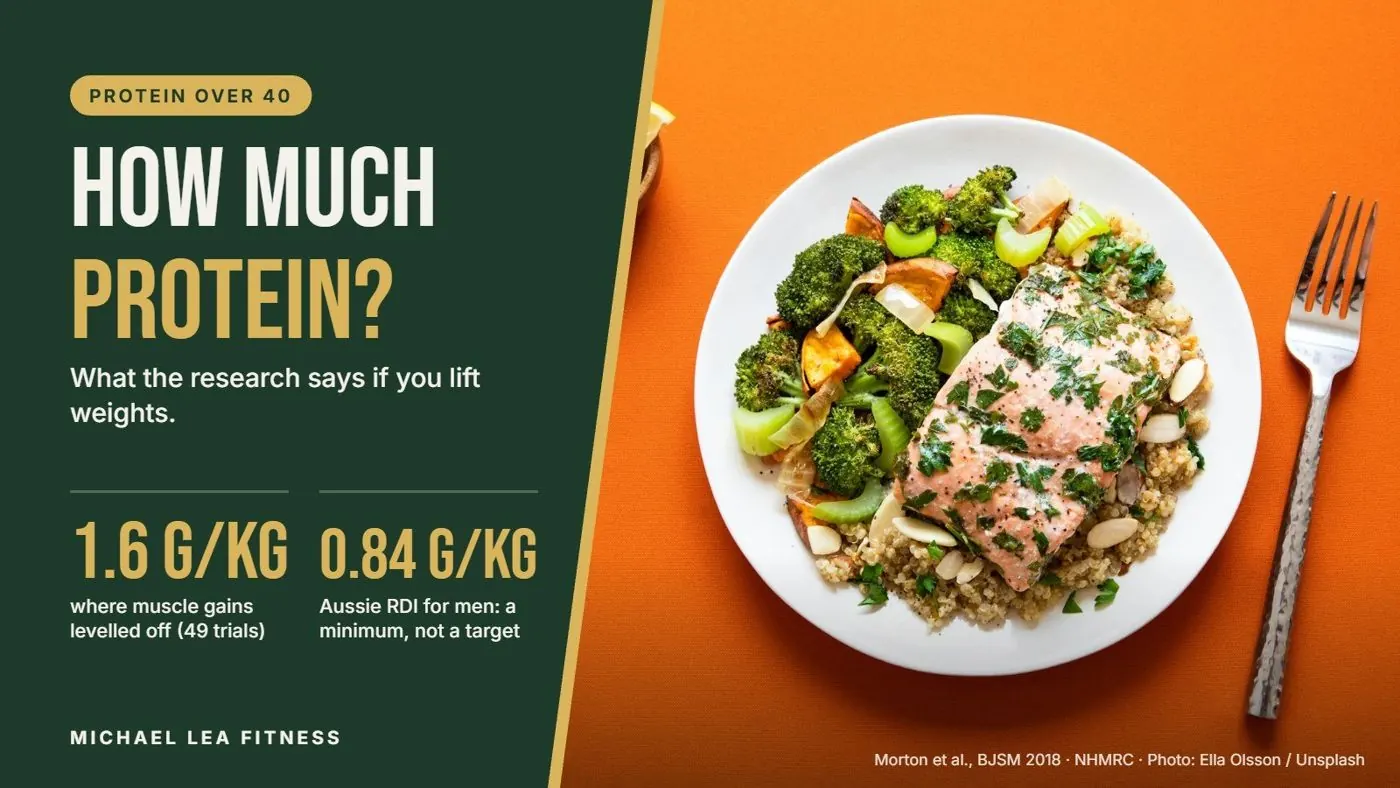
Australia's official Recommended Dietary Intake (RDI) is 0.84 g of protein per kilogram of body weight a day for men aged 19 to 70, and 0.75 g/kg for women. Over 70, it rises to 1.07 g/kg for men and 0.94 g/kg for women (Eat For Health, Nutrient Reference Values).
The key thing to understand is what an RDI is for. It's set to cover the needs of nearly all healthy people. It's a floor for staying healthy, not a target for building muscle while you train.
How much protein do you need to build muscle?
The best evidence comes from a large meta-analysis of 49 randomised trials with 1,863 people. Adding protein to a strength training program led to bigger gains in strength and muscle than training alone. The benefit levelled off at a total intake of around 1.6 g/kg of body weight a day. Eating more than that didn't add any more muscle (Morton et al., 2018).
A second dose-response analysis landed in almost the same place. Strength gains rose with protein intake up to about 1.5 g/kg a day, then flattened out (Tagawa et al., 2022).
So for most people who lift, somewhere around 1.2 to 1.6 g/kg a day is a sensible range. For an 80 kg person, that's roughly 95 to 130 g of protein a day, compared with an RDI of about 67 g.
Does protein work without training?
This is the part most supplement ads skip. In the dose-response analysis, extra protein only improved strength when people were also doing resistance training. Without training, there was no meaningful benefit (Tagawa et al., 2022).
The same pattern showed up in older adults. A meta-analysis of studies in people with an average age of 50 and over found that extra protein on its own didn't improve muscle mass or strength. Combined with resistance exercise, it did lead to more leg and arm muscle and better grip strength (Kirwan et al., 2022). Protein supports the training. It doesn't replace it.
Do you need more protein as you get older?
Possibly. Muscle becomes less responsive to protein with age, which is one reason the Australian RDI rises after 70. In the big meta-analysis, the extra boost from protein shrank slightly as age went up (Morton et al., 2018). That's not a reason to give up. It's a reason to make sure your protein intake is solid and your training is consistent.
A personal trainer's tips for getting enough protein
- Work out your number. Multiply your body weight in kilograms by 1.2 to 1.6. That's your daily target range if you're strength training.
- Spread it out. Aim for a decent serve of protein at each meal rather than one big dinner. Three or four meals of 25 to 40 g each makes the number easy to reach.
- Start with food. Eggs, Greek yoghurt, milk, fish, chicken, lean red meat, tofu, lentils and beans all count. A shake is a convenience, not a requirement.
- Train consistently. The research is clear that protein works best alongside resistance training.
- Check with your GP or a dietitian if you have kidney disease or another medical condition before increasing your protein intake.
What this looks like in a 30-minute session in Redcliffe
Protein only does its job if you give your muscles a reason to grow. A 30-minute personal training session at my Redcliffe studio is built around exactly that: a short warm-up, then compound lifts like squats, hinges, rows and presses, with the weights increased as you get stronger. Outside the gym, we keep nutrition simple: a protein target, a few go-to meals, and regular check-ins so it actually sticks.
The bottom line
Most adults who lift weights will do better on more protein than the Australian RDI, with the research pointing to about 1.6 g/kg a day as the point where extra protein stops adding muscle. But protein is the support act. Consistent strength training is what drives the result.
Protein FAQs
Is too much protein bad for you?
For healthy people, intakes in the range discussed here are generally considered safe. If you have kidney disease or another medical condition, speak with your GP or a dietitian first.
Do I need protein shakes?
No. Shakes are a convenient way to top up, but food works just as well. The total you eat across the day matters most.
How much protein is in common foods?
Check the nutrition panel on the label. As a guide, a palm-sized serve of meat, chicken or fish, a tub of high-protein yoghurt, or a few eggs will usually get a meal most of the way there.
Personal training in Redcliffe and Brisbane's northside
If you're around Redcliffe, Scarborough, Clontarf, Margate, Kippa-Ring or anywhere in Moreton Bay and want a simple plan for training and eating that gets results, let's talk. Book a free consultation: call or text Michael on 0414 183 715 or email michael.lea.pt@gmail.com.
References
Morton RW, et al. A systematic review, meta-analysis and meta-regression of the effect of protein supplementation on resistance training-induced gains in muscle mass and strength in healthy adults. Br J Sports Med. 2018;52(6):376-384. doi:10.1136/bjsports-2017-097608
Tagawa R, et al. Synergistic effect of increased total protein intake and strength training on muscle strength: a dose-response meta-analysis of randomized controlled trials. Sports Med Open. 2022;8(1):110. doi:10.1186/s40798-022-00508-w
Kirwan RP, et al. Protein interventions augment the effect of resistance exercise on appendicular lean mass and handgrip strength in older adults: a systematic review and meta-analysis of randomized controlled trials. Am J Clin Nutr. 2022;115(3):897-913. doi:10.1093/ajcn/nqab355
National Health and Medical Research Council. Nutrient Reference Values for Australia and New Zealand: Protein. Eat For Health.
Photo: Ella Olsson on Unsplash.