Sore After Training? What Actually Helps (and What Doesn't)
Why muscle soreness happens, why it fades fast, and what the research says actually helps
You start a new program, have a great session, and two days later you can barely walk down the stairs. As a personal trainer in Redcliffe, I hear about it every week, especially from people who are new to strength training or coming back after a break. Muscle soreness is normal, it's usually harmless, and it gets much better quickly. Here's what the research says about why it happens and what actually helps.
Why are my muscles sore a day or two after training?
That delayed ache has a name: delayed-onset muscle soreness, or DOMS. It usually shows up after exercise your body isn't used to, especially movements where the muscle works while lengthening, like lowering into a squat or walking downhill. It's a sign your muscles have been given a new challenge. It isn't a sign you've injured yourself, and it isn't a measure of how good the workout was.
Does muscle soreness get better the more you train?
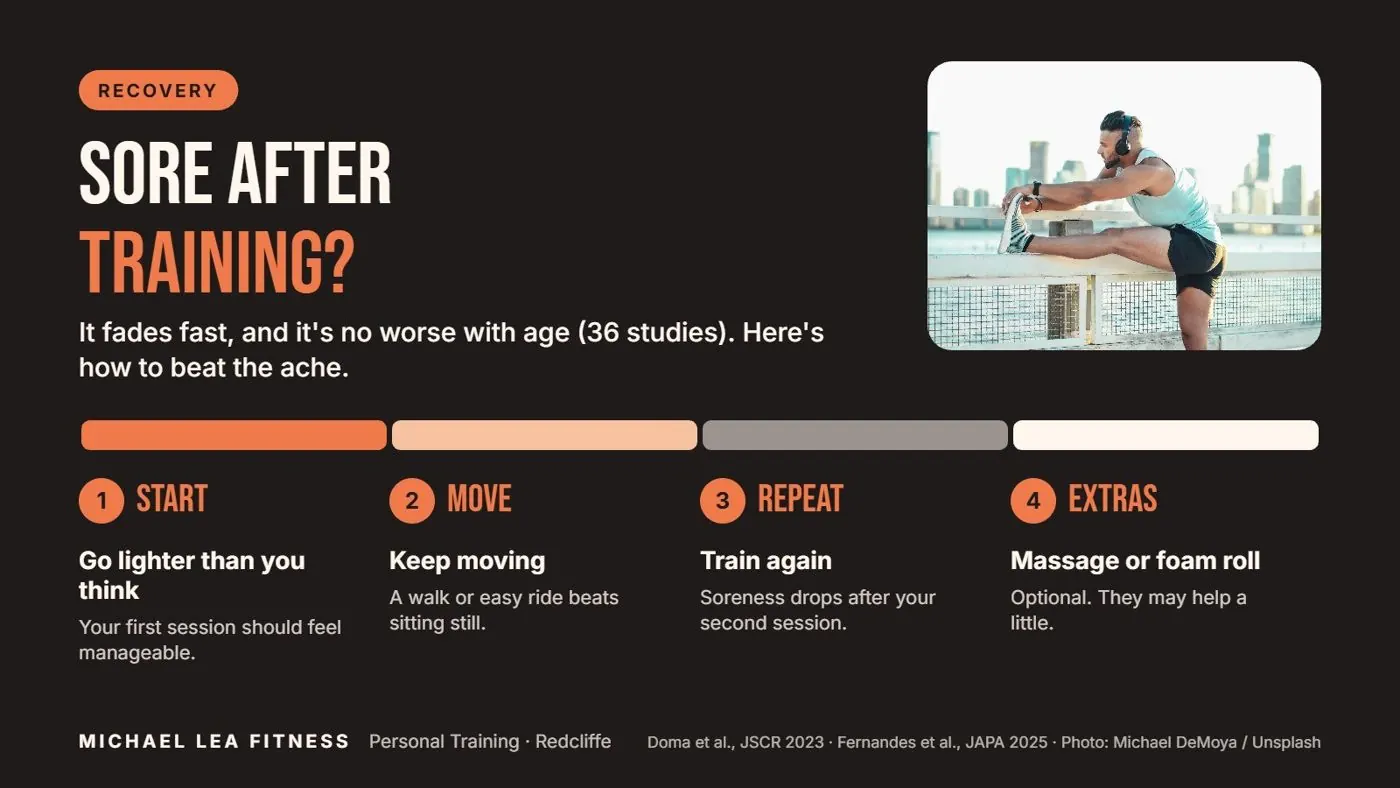
Yes, and quickly. Researchers call it the repeated bout effect. A 2023 meta-analysis of 20 studies looked at everyday multi-joint exercises like squats and lunges. Soreness and markers of muscle damage were significantly lower after the second session than after the first, and strength bounced back faster too (Doma et al., 2023). One session is enough to start protecting your muscles for the next one.
That's why the first week of a new program is usually the worst. Keep turning up and the soreness settles down.
Do you get more sore as you get older?
This is one of the most common worries I hear from clients over 40, and the research is reassuring. A 2025 meta-analysis of 36 studies compared younger and older adults doing the same exercise. Loss of muscle function was no different between the two groups, and the older adults actually reported less soreness than the younger ones (Fernandes et al., 2025). The authors concluded that older adults can be active regularly without worrying about more muscle damage.
Does stretching help muscle soreness?
Not much, unfortunately. A Cochrane review of 12 studies found that stretching before or after exercise reduced soreness the next day by about one point on a 100-point scale. That's far too small to notice (Herbert et al., 2011). Stretch because it feels good or helps your mobility, not because it will stop you being sore.
Does foam rolling or massage help with sore muscles?
A little. A meta-analysis of 21 studies found foam rolling after exercise reduced how sore people felt by about 6%, but overall the effects on recovery were small (Wiewelhove et al., 2019). A larger review of 99 studies compared many recovery methods. Massage came out as the most effective for soreness and fatigue. Active recovery, compression garments, cold water immersion and cryotherapy also reduced soreness, by small to large amounts (Dupuy et al., 2018).
One honest caveat: a 2026 network meta-analysis in endurance athletes found that no recovery method clearly beat simply resting, and a fake "sham" treatment did as well as the real ones (Jin et al., 2026). Some of what people feel from recovery gadgets may come down to expecting them to work. If something helps you feel better, use it. Just don't spend a fortune.
A personal trainer's tips for managing muscle soreness
- Start lighter than you think. The first session of a new program should feel comfortably manageable. You'll get the benefit with far less soreness.
- Keep moving. A walk, an easy bike ride or a light session often makes sore muscles feel better than sitting still.
- Be consistent. Training regularly is the best protection against soreness, thanks to the repeated bout effect.
- Use massage or foam rolling if you enjoy them. They may take the edge off, but they're optional.
- Know the difference between sore and hurt. General muscle ache that eases as you warm up is normal. Sharp pain, swelling, pain in a joint, or very dark urine after a hard session are reasons to stop and see your GP.
What this looks like in a 30-minute session in Redcliffe
When someone new starts personal training at my Redcliffe studio, the first few 30-minute sessions are deliberately easier than they could be. We start with lighter weights and fewer sets, then build up week by week as your body adapts. That way you get stronger without spending your first fortnight hobbling around Redcliffe. For outdoor sessions, the same rule applies to hills and stairs: start with a few efforts and add more over time.
The bottom line
Muscle soreness after a new workout is normal, it fades fast as you keep training, and it doesn't get worse with age. Stretching won't do much for it, and massage or foam rolling may help a little. The real fix is simple: start sensibly, keep moving and stay consistent. That's how I approach it with every personal training client in Redcliffe.
Muscle soreness FAQs
Should I train if I'm still sore?
Usually yes, as long as it's general muscle soreness rather than pain. Train a different muscle group, or do a lighter session. Movement often helps the soreness ease.
Does no soreness mean the workout didn't work?
No. Soreness mostly reflects how new an exercise is to you, not how effective it was. As you adapt, you'll get less sore while still getting stronger.
Are ice baths worth it?
Cold water immersion may reduce soreness a little, but the evidence is mixed and the effect may partly be expectation. They're optional, not essential.
Personal training in Redcliffe and Brisbane's northside
If you're around Redcliffe, Scarborough, Clontarf, Margate, Kippa-Ring or anywhere in Moreton Bay and want to start training without spending a week sore, let's talk. Book a free consultation: call or text Michael on 0414 183 715 or email michael.lea.pt@gmail.com.
References
Doma K, et al. The repeated bout effect of multiarticular exercises on muscle damage markers and physical performances: a systematic review and meta-analyses. J Strength Cond Res. 2023;37(12):2504-2515. doi:10.1519/JSC.0000000000004628
Fernandes JFT, et al. Advancing age is not associated with greater exercise-induced muscle damage: a systematic review, meta-analysis, and meta-regression. J Aging Phys Act. 2025;33(6):606-624. doi:10.1123/japa.2024-0165
Herbert RD, et al. Stretching to prevent or reduce muscle soreness after exercise. Cochrane Database Syst Rev. 2011;(7):CD004577. doi:10.1002/14651858.CD004577.pub3
Wiewelhove T, et al. A meta-analysis of the effects of foam rolling on performance and recovery. Front Physiol. 2019;10:376. doi:10.3389/fphys.2019.00376
Dupuy O, et al. An evidence-based approach for choosing post-exercise recovery techniques to reduce markers of muscle damage, soreness, fatigue, and inflammation: a systematic review with meta-analysis. Front Physiol. 2018;9:403. doi:10.3389/fphys.2018.00403
Jin Y, et al. Physical recovery modalities in competitive and elite endurance athletes: a systematic review and network meta-analysis finding limited evidence of benefit over passive recovery. Front Sports Act Living. 2026;8:1876924. doi:10.3389/fspor.2026.1876924
Photo: Michael DeMoya on Unsplash.