Do You Really Need 10,000 Steps a Day?
What the latest research says about how many steps a day you actually need
Ten thousand steps a day has become the magic number. It's the default goal on most smartwatches and the target plenty of my clients chase around the Redcliffe foreshore. But as a personal trainer in Redcliffe, I get asked all the time whether you really need to hit it. The latest research says probably not, and that's good news if you're busy. Here's what the evidence actually shows.
Where does the 10,000 steps a day goal come from?
Not from science. When researchers set out to test it, they noted that although 10,000 steps a day is widely promoted, there was little evidence to support that particular number (Paluch et al., 2022). It's a round, memorable figure, not a threshold your body cares about.
How many steps a day do you actually need?
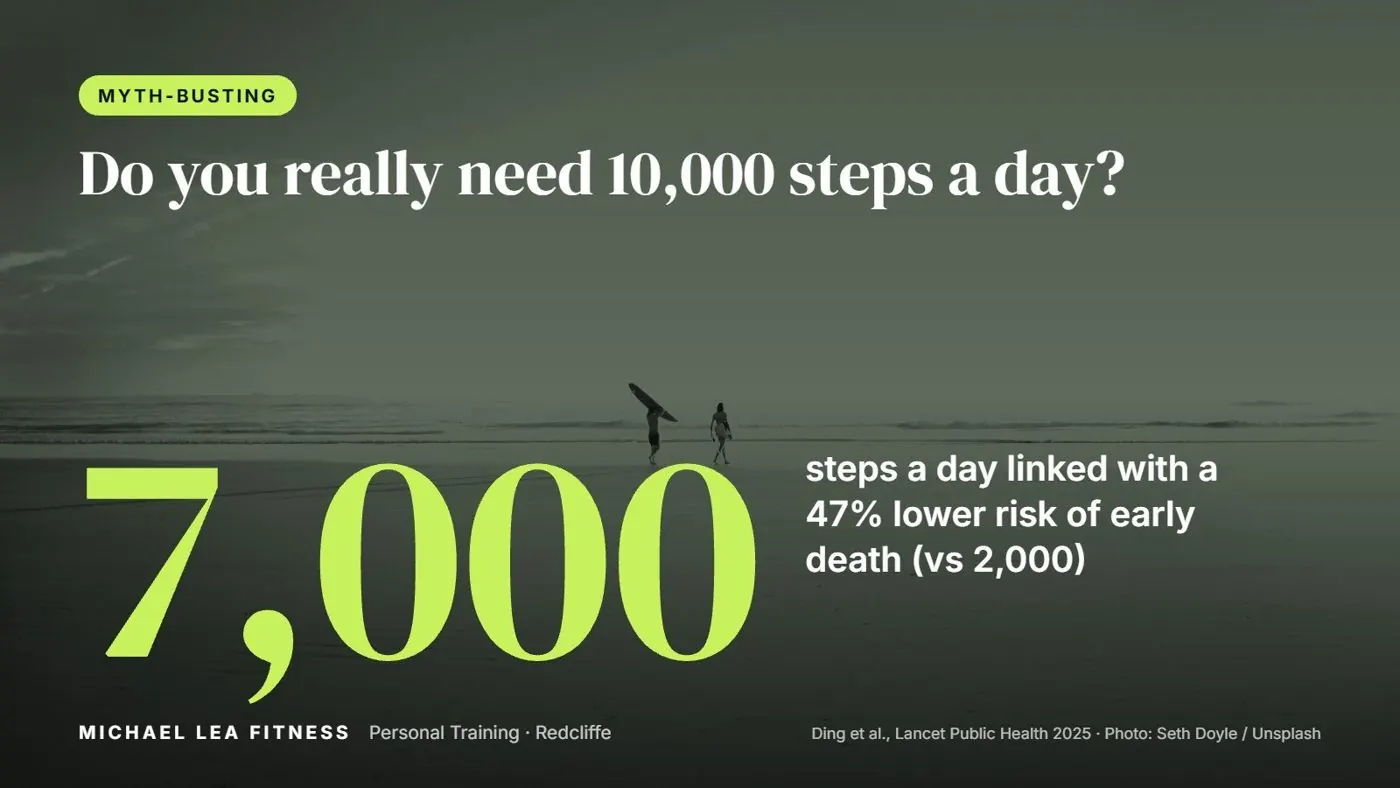
A major 2025 review led by researchers at the University of Sydney pooled 57 studies on daily steps and health. Compared with 2,000 steps a day, people who walked about 7,000 steps a day had a 47% lower risk of dying early, a 25% lower risk of heart disease, a 38% lower risk of dementia, a 22% lower risk of depressive symptoms and a 28% lower risk of falls. For several of these, most of the benefit had kicked in by around 5,000 to 7,000 steps (Ding et al., 2025).
The authors' conclusion was refreshingly practical: 10,000 steps is still a great target if you're already active, but 7,000 a day brings meaningful health benefits and is more realistic for many people.
Does the right number of steps change with age?
It seems to. A meta-analysis of 15 studies and more than 47,000 adults found the risk of dying early kept dropping as steps went up, then levelled off at about 6,000 to 8,000 steps a day in adults aged 60 and over, and at about 8,000 to 10,000 steps a day in younger adults (Paluch et al., 2022).
For heart health specifically, a separate analysis found that in adults over 60, more daily steps were linked with a steadily lower risk of heart disease and stroke (Paluch et al., 2023).
Is every extra step worth it?
Yes, especially if you're starting low. A meta-analysis of 17 studies and nearly 227,000 people found that every extra 1,000 steps a day was linked with a 15% lower risk of dying early, and every extra 500 steps with a 7% lower risk of dying from heart disease (Banach et al., 2023). You don't have to jump from 3,000 to 10,000 overnight. Each small step up counts.
One honest caveat: these are observational studies. They show strong links, not proof that steps alone cause the benefits, and people who walk more often have other healthy habits too.
Can walking more help your mood?
It's linked with it. A 2024 meta-analysis of 33 studies and more than 96,000 adults found that people who took 7,000 or more steps a day had a 31% lower risk of depression than those who took fewer, and every extra 1,000 steps was linked with a 9% lower risk (Bizzozero-Peroni et al., 2024).
A personal trainer's tips for getting more steps
- Know your starting point. Check your average over a normal week, then aim to add 1,000 steps a day rather than chasing a big number straight away.
- Stack walks onto habits. A 10-minute walk after meals, walking while you're on the phone, or parking further away all add up quickly.
- Use the coastline. A loop of the Redcliffe foreshore or Scarborough's waterfront is one of the easiest ways to bank a few thousand steps before work.
- Don't stop at steps. Walking is brilliant for health, but it doesn't replace strength training for muscle and bone. You need both.
- Check with your GP if you have a heart condition, joint problems or another health issue before ramping up your walking a lot.
What this looks like in a 30-minute session in Redcliffe
A 30-minute personal training session at my Redcliffe studio covers what walking can't: strength, power and muscle. Outdoors, we often use hill walks, stair climbs and loaded carries around the peninsula, which add steps and strength at the same time. Between sessions, I give clients a realistic daily step target based on where they're starting, not a one-size-fits-all 10,000.
The bottom line
You don't need to hit 10,000 steps a day to get most of the health benefits of walking. Around 7,000 a day is linked with big reductions in the risk of early death, heart disease, dementia and depression, and every extra 1,000 steps helps. Walk more than you do now, pair it with strength training, and keep it going. That's exactly how I approach it with my personal training clients in Redcliffe.
Daily steps FAQs
Is 10,000 steps a day bad?
Not at all. If you already hit it, keep going. The research simply shows you don't need that many to get meaningful benefits.
Does walking pace matter?
Total steps showed the clearest links with health in the research. If you want extra benefit, add some brisk walking or hills, but getting the steps in comes first.
Do steps from my workouts count?
Yes. Steps from walking, running, sport or a training session all count towards your daily total.
Personal training in Redcliffe and Brisbane's northside
If you're around Redcliffe, Scarborough, Clontarf, Margate, Kippa-Ring or anywhere in Moreton Bay and want a simple plan for walking, strength and staying healthy for the long haul, let's talk. Book a free consultation: call or text Michael on 0414 183 715 or email michael.lea.pt@gmail.com.
References
Ding D, et al. Daily steps and health outcomes in adults: a systematic review and dose-response meta-analysis. Lancet Public Health. 2025;10(8):e668-e681. doi:10.1016/S2468-2667(25)00164-1
Paluch AE, et al. Daily steps and all-cause mortality: a meta-analysis of 15 international cohorts. Lancet Public Health. 2022;7(3):e219-e228. doi:10.1016/S2468-2667(21)00302-9
Paluch AE, et al. Prospective association of daily steps with cardiovascular disease: a harmonized meta-analysis. Circulation. 2023;147(2):122-131. doi:10.1161/CIRCULATIONAHA.122.061288
Banach M, et al. The association between daily step count and all-cause and cardiovascular mortality: a meta-analysis. Eur J Prev Cardiol. 2023;30(18):1975-1985. doi:10.1093/eurjpc/zwad229
Bizzozero-Peroni B, et al. Daily step count and depression in adults: a systematic review and meta-analysis. JAMA Netw Open. 2024;7(12):e2451208. doi:10.1001/jamanetworkopen.2024.51208
Photo: Seth Doyle on Unsplash.